

The final whistle doesn't end the game. Today's sports fan engagement lives on the phone – in the scroll, notification, highlight reel delivered before you even think to look for it. 70% of fans say digital experiences keep them more engaged with their teams.
If the game fills 90 minutes, loyalty is built in everything around it. AI, including voice technology, is now part of how the best organizations build that experience.
Below are 8 strategies — and what each one looks like in practice.
Key Takeaways
- Half of Gen Z sports viewers don't watch full games. Snackable content and year-round digital touchpoints are how you get fan loyalty.
- Digital fan engagement is every interaction a fan has with a team between fixtures. Get that right and matchday takes care of itself.
- Ethical AI fan engagement starts with a human performance and a signed agreement. Languages, scale, synthesis follow from that.
What Is Fan Engagement in Sports?
Fan engagement in sports is the relationship between a team and its audience — built before the game, during it, and in every moment between fixtures. It covers three distinct dimensions:
-
Transactional (tickets, merchandise, in-app spending)
-
Behavioral (social activity, content consumption, app usage)
-
Emotional (loyalty, identity, community)
Fans who feel personally connected to a team spend more, share more, and stay longer — with or without a trophy run.
Why Fan Engagement in Sports Matters More Than Ever
A decade ago, how to engage sports fans meant broadcast deals and ticket sales. Now it means earning a place on a screen already full of other things. Only about half of Gen Z sports viewers watch full games. 63% say short clips from their favorite athletes on social media do more for their engagement than the broadcast itself.
Sports organizations are putting serious money where the fans are. By 2030, the global sports technology market reaches $68.7 billion. Now it’s clear that organizations that win at digital fan engagement win the long game.
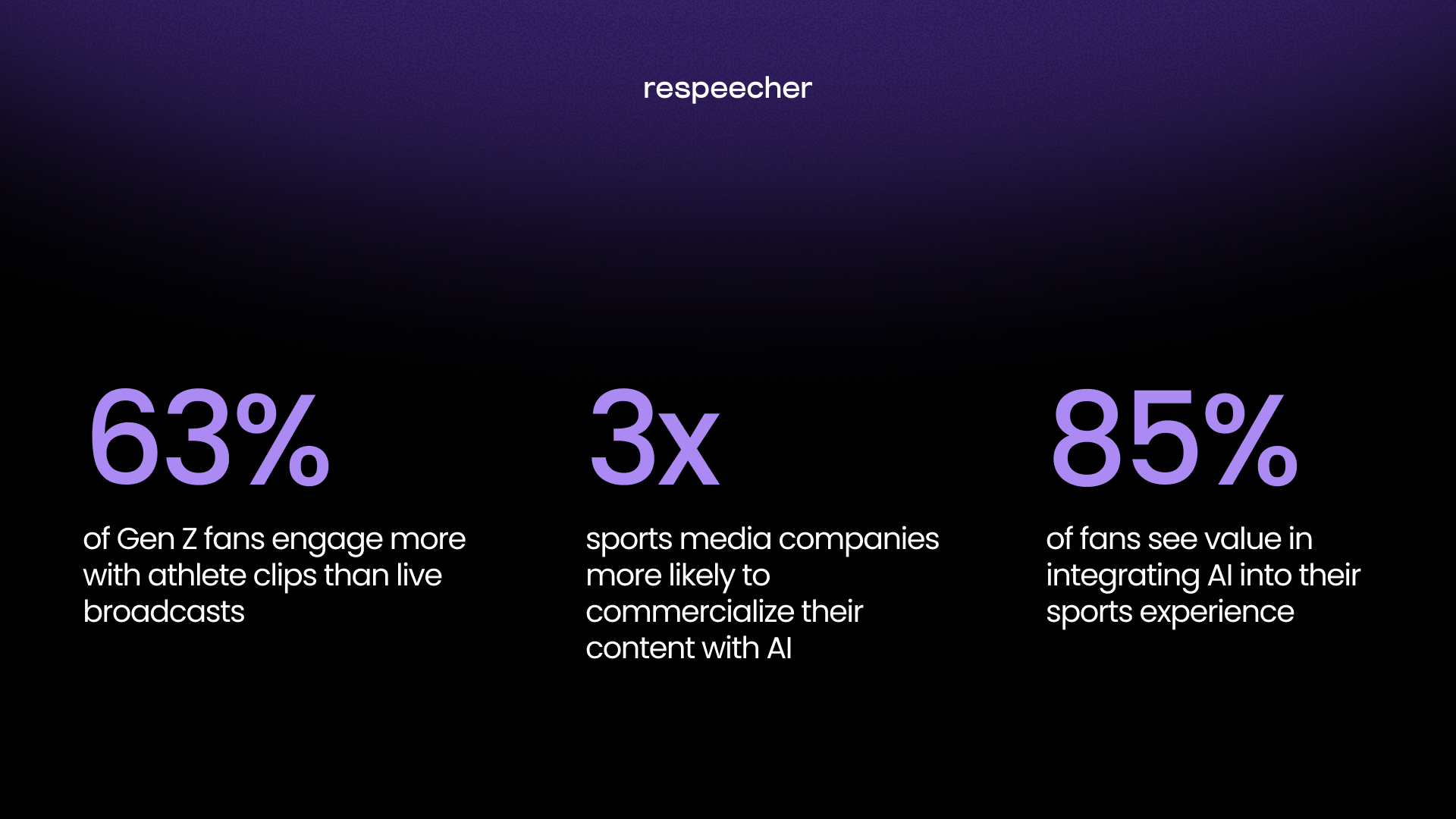
Sports media companies that have already adopted AI fan engagement tools are 3x more likely to find it easier to commercialize their content than those that haven't. 85% of fans already see value in integrating AI into their sports experience. -
The appetite for smarter fan engagement ideas in sports is there. What's missing is the right strategy.
Best Fan Engagement Strategies in Sports
Ready to level up your knowledge? These gaming trends are changing how studios build, fund and ship in 2026.
1. Personalization at Scale
Nobody rewinds a generic recap. Sports fan engagement starts the moment content feels like it was made for one person — what they watch, skip, share, and click back to. AI reads those signals and builds around each individual. When it lands right, they don't leave.
2. Real-Time Interactive Experiences
A fan who predicts the next play has skin in the game. The moment you vote on a post-game call or challenge a referee decision, you're invested in a different way — one that's much harder to switch off.
In-game prediction tools, live polling, second-screen apps — these fan engagement ideas in sports already exist. The question is whether you're using them.
3. Community Building
Sports fandom has always been communal. What's changed is where the community lives — and building that space is one of the most underused fan engagement strategies in sports. Teams that own it—a Discord, a club app—build loyalty that survives a bad season.
4. Social Media & User Generated Content Activation
Fan-made content travels further than branded content. The best of it is probably already on someone's phone. User Generated Content (UGC) is one of the simplest sports fan engagement ideas — and one of the most effective: a distribution channel you didn't have to build.
5. Gamification & Fantasy Leagues
Fantasy leagues changed what it means to follow a sport. A fan with a roster has a reason to watch games they'd otherwise skip. Gamification in sports fan engagement takes that further — leaderboards and prediction challenges keep fans coming back on days when there's no fixture to watch.
6. Immersive Tech: AR and VR Experiences
AR and VR have moved past novelty — they're now part of what younger audiences measure the fan experience in sports against. A generation that grew up inside immersive gaming environments doesn't lower that standard when the sport goes live.
Fan engagement technology that meets it earns attention; everything else competes with a game controller.
7. AI Voice Experiences
A fan in São Paulo hears the announcer they grew up with; a supporter in Seoul gets a message from their favorite athlete. AI voice for sports makes both possible — AI voice generation built on real human performance, extended through voice cloning into new languages and new content. The voice owner's consent comes before any of it.
Respeecher has built exactly this for sports broadcasts, documentaries, and live events. If you're exploring what ethical AI voice looks like in practice, see how we work.
8. Year-Round Digital Touchpoints
Fans don't hibernate between seasons — they just find something else to watch. Year-round digital touchpoints keep the fan experience in sports alive when there's no scoreline to talk about.
Player stories, behind-the-scenes access, training updates: small moments that add up to fan loyalty that doesn't need a trophy to survive.
Real-World Examples of Fan Engagement Done Right
The best sports fan engagement examples don't come from whitepapers. They come from a Super Bowl field, a Puerto Rico Olympic broadcast, and a season schedule announcement that became a cultural moment.
Four cases where the strategy was right, the technology was ready, and the fans noticed.
Case 1: The NFL and Adobe
Schedule release day: the one moment every NFL fan is paying attention. But they stopped wasting it on a single blast. Instead, each of the 200 million+ fans got something different — personalized content and tailored ticket offers across all 32 clubs, built around their team, their history, and their preferences.
"What could have been a routine, transactional announcement became a shareable cultural moment that drove record engagement, higher ticket sales, and revenue for many clubs."
— Josh Rabenovets, VP of Fan Engagement, NFL
Case 2: The IOC Paris 2024
The IOC went into Paris 2024 with a Fan Data Platform built with Deloitte they didn't have for Tokyo. It ran across 12 languages, segmented fans by sport and preference, and kept 16 million people regularly engaged throughout the Games.
The digital fan experience it powered:
-
12 billion social engagements on the IOC's own channels
-
300 million using the app and website
-
Tokyo 2020's numbers left behind
Case 3: The LA Rams and RCS Messaging
The LA Rams had 10,000+ fans who needed to hear about the new season schedule. They could have sent a text. But they sent an experience.
As the first US sports team to use Rich Communication Services (RCS) messaging — rich media, two-way conversation, verified branding — they reached 10,000+ fans with personalized ticket offers on schedule release day. Up to 70% lift in engagement and 60%+ increase in ticket sales.
"For decades, marketers have been asking, 'How do we build a white glove, one-to-one relationship at scale?' RCS for Business allows us to curate what fans want to know in a real-time experience so they can sit back, relax, and trust that we've got them covered."
— Kathryn Kai-ling Frederick, CMO, Los Angeles Rams
Case 4: Respeecher and the Puerto Rico Olympic Broadcast
Manuel Rivera Morales called Puerto Rican basketball for decades. He wasn't there for the women's team's Olympic debut — but his voice was.
Respeecher trained a machine learning model on archival recordings in 10 days, then synthesized the full 1 hour 50 minute broadcast in just 5 hours. Multiple SME Gold awards followed. It started, as everything does, with consent.
"[Respeecher’s] attentiveness to detail and dedication to this project allowed us to reconnect with one of our lost narration idols in Puerto Rico, Manuel Rivera Morales, on a new level. It gave his family and PR a glimpse of what could have been if he was still alive."
— Edgardo Rivera, President & CEO, DDB Puerto Rico
Final Thoughts
Great sports fan engagement doesn't announce itself. Fans don't think about the data platform, the RCS campaign, or the AI model trained on archival audio. They just feel closer to the game.
The teams winning in 2026 treat fan engagement as a strategy, not a matchday checklist. The ones adding AI voice for sports to that foundation are finding moments nobody thought were possible — a voice from the past calling a historic debut, a legendary coach back on the field five decades later.
That standard exists. If you're building something that needs it, start here.